This page answers the question “what is Yuneta, as a model?” — the conceptual claim that underpins the engineering choices laid out in Design Principles and the vocabulary in Domain Model.
The short version: Yuneta treats data and behavior as two views of the same typed graph. Most stacks have a database for “what is” and a separate process model for “what happens”. Yuneta unifies them under one set of primitives. Everything you build — a node in a topic, a running service, a TCP socket, a subscription, an authorization rule — is an instance of a typed class connected to other instances by typed links.
This page is for readers who want to understand the framework as a whole before learning its surface area. None of it is required to write working code, but it explains why the surface area is shaped the way it is.
The unit is not “node + edge”. It is “typed instance with typed bindings”
A graph in mathematics has nodes and edges. The distinctive choice in Yuneta is that every edge carries a contract:
A treedb
hookis not “there is a link” — it is “this kind of link, between these two topics, with this name, with this cardinality, validated at insert time”.A gobj event like
EV_ON_OPENis not a string — it is a declared event type in theevent_types[]table with a schema for itskwpayload, and the FSM rejects events the current state does not accept.A command is not a free-form RPC — it is a
SDATACM2registration with apm_xxx[]parameter descriptor, type-checked before reaching the handler.A subscription is not “callback registered” — it is a typed binding between publisher gobj, event type, and subscriber gobj that the framework can introspect at runtime.
This is what separates the model from neighbouring designs:
Untyped graph databases (RDF, basic property graphs) type the nodes but treat the edge as opaque metadata.
Untyped actor systems (Erlang/OTP, classic Akka) type the process but pass arbitrary terms as messages.
Object-oriented frameworks type the object but rarely enforce a declared FSM per class.
Yuneta types all three at once: the node, the link, and the lifecycle.
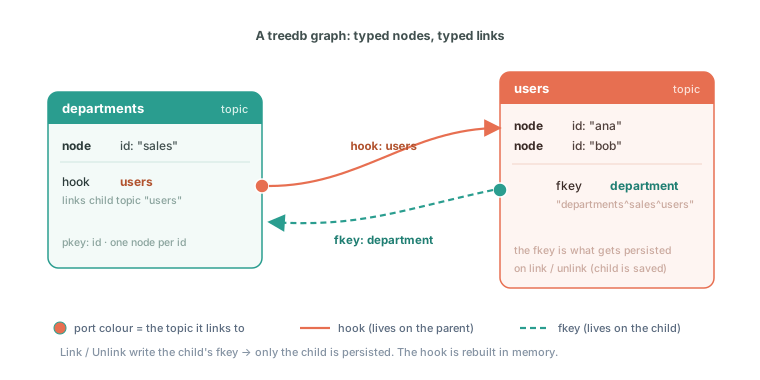
A treedb graph reads left to right. The departments topic declares a
users hook; each users node carries a department fkey back.
The binding is typed — this link, between these two topics, with
this name. A port’s colour marks the topic it links to. Link/Unlink
write the child’s fkey, so only the child is persisted; the parent’s
hook list is rebuilt in memory on load.
Two graphs, one set of primitives
Yuneta has two graphs running side by side. They are not analogous — they are isomorphic in primitive shape:
| Information plane (treedb) | Behavior plane (gobj-tree) |
|---|---|
topic | gclass |
node (with id) | gobj (with gobj_name) |
hook / fkey | parent / subscribe / bottom_gobj |
field schema (sdata_desc_t) | attribute schema (sdata_desc_t) — same macro family |
EV_TREEDB_UPDATE_NODE | EV_ON_OPEN, EV_TIMEOUT, … |
timeranger2 (persistence) | yev_loop (scheduler) |
The same SDATA() macro family declares the columns of a user record
in treedb_authzs and the attributes of a C_TCP gobj. The same
notion of “subscriber” expresses both “this gobj listens for events
from that one” and “this node points to that one”. One mental model
covers both planes — the difference is whether the binding is static
(data: who relates to whom) or dynamic (behavior: who reacts to
whom).
See GObj crash course and TreeDB crash course for the concrete APIs on each plane.
What this lets you model
Because both planes share primitives, you can express almost any kind of organization as some combination of typed nodes and typed links:
Strict hierarchies — a single parent hook. The gobj-tree itself is built this way. So is any topic that links back to a parent of the same type.
Matrix or many-to-many — multiple
fkeyfields on a child node, each pointing to a different parent topic. Bipartite (users ↔ roles) or multipartite (users ↔ roles ↔ permissions ↔ services) just fall out of the schema.treedb_authzsis exactly this shape.Workflows and state machines — the topic-of-states pattern: a topic where each row is a state and
next_stateis a self-fkey. And, on the behavior plane, every gclass already is a finite state machine, so workflows expressed as gclasses get FSM enforcement for free.Communication topologies — gates, channels, protocols and subscriptions form a graph parallel to the data graph. Who can send what to whom, with delivery semantics (sync command vs. published event vs. queued message) baked into the binding type.
Versioned relations over time — every treedb write appends a new record with a fresh
g_rowidand a timestamp. The current view is a projection of the latest non-deleted row perid. Historical reconstruction is a matter of choosing a different cut-off.
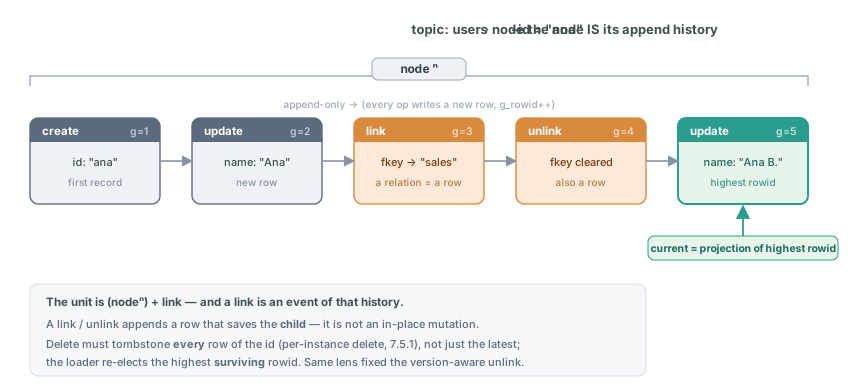
A node is not a cell — it is its append history, nodeⁿ. Each
create / update / link / unlink appends a row; a relationship change
is an event in the history (it saves the child), not an in-place edit.
The current node is the projection of the highest g_rowid. This is why
a durable delete must tombstone every row of the id, and why unlink
must find the right version — the two fixes shipped in 7.5.1.
What this does not let you model cleanly
The same constraint that gives you uniform composition also has costs. Worth being honest about where the model strains:
Schemaless, rapidly-iterating data — you pay the cost of declaring topics, fields and hooks upfront. Tools that let you stuff arbitrary JSON and worry later (MongoDB, Firestore) get you faster to a first running prototype.
OLAP / analytical workloads over large relations —
timeranger2is an append-only OLTP store optimised for primary-key and time-range access. Aggregate joins across tens of millions of rows live elsewhere (Postgres, ClickHouse), with Yuneta acting as the upstream that produces those rows.Eventually-consistent distributed state — Yuneta is one yuno per CPU core, and multi-yuno coordination happens through explicit message gates. The model is closer to CSP than to Paxos. If you need transparent multi-master replication, that is a layer you build on top of Yuneta, not something the framework gives you.
Truly opaque payloads — anything that genuinely cannot be typed becomes a
json_t *blob or a base64 string in auser_datafield. Those are the cracks where the model lets through what it cannot classify, and they are worth treating as design smells when they appear in new code.
The implicit axiom
Pulled tight, the philosophy is one sentence:
A system is fully described by (a) the set of typed instances that exist plus (b) the set of typed bindings between them. Everything else — state, capacity, behavior, authorization, communication — is an attribute of an instance or a property of a binding.
This is reductive in the same way physics is reductive. It forces you to express things in a small vocabulary, and in exchange the rest of the system can reason about them uniformly. The reward shows up at scale: tools, traces, FSM enforcement, supervision and substitution all keep working as the codebase grows, because every new piece slots into the same shape.
The price shows up when something really does not fit (a free-form blob, an unowned side-effect, an operation with no clear locus). You either deform it to fit or leave it as a leak in the model. Catching those moments early — and either tightening the schema or admitting the leak explicitly — is the running design discipline.
What you get in practice
The payoffs that justify the upfront typing cost:
Uniform composition at every scale. A TCP socket is a gobj. A protocol on top is a gobj that owns the socket as
bottom_gobj. A service is a gobj that owns the protocol. A yuno is a gobj that owns services. The agent is a gobj that owns yunos. The same primitive (gobj_subscribe_event,gobj_send_event) works at every level.Substitution by contract. Swap OpenSSL ↔ mbedTLS under
C_YTLSand the layers above do not notice. Swapc_tcpforc_unix_socketand the protocols stay blind. The contract is the gclass signature. The implementation behind it is interchangeable.Structural traceability.
gobj_short_name(g)returns the full path through the tree (C_YUNO^...^C_AUTH_BFF^auth_bff^C_HTTPS_CL^...^C_TCP^...). You know where in the graph something is happening without bolting on ad-hoc tracing. The same applies to nodes — every treedb record carries metadata identifying its topic, treedb and rowid.One vocabulary to learn. Once you understand “typed class + typed instance + typed binding + schema”, you can read any layer of Yuneta — kernel, ytls, treedb, application service, GUI declarative shell — without switching mental models.
The empirical justification
The implicit bet of Yuneta is that paying to type everything amortises over many years of production. The bet was honoured: the same model (under earlier names — v2, v6) was running at industrial scale for over fifteen years in deployments where downtime is expensive and operator turnover is real. The current v7 codebase inherits from that empirical history. Consequently, when a design choice looks strange, the answer is more often “this was learned in production” than “this is theory”.
Where to go next
Design Principles — the engineering “why” for each individual decision.
Domain Model — the concrete vocabulary you use to model reality with the primitives described here.
Architecture — the third layer built on these two planes: services and roles as data, changed while the system runs.
Inspiration — where the words came from, written in a non-technical register.
GObj framework crash course — concrete API on the behavior plane.
timeranger2 + treedb crash course — concrete API on the information plane.