What is a GClass?
A GClass (short for GObject Class) is a core construct in the Yuneta framework. It defines the behavior, attributes, and structure of GObjects (runtime instances of a GClass). The GClass encapsulates the function and state machine of a particular object type, serving as a blueprint for creating and managing GObjects.
A GClass in Yuneta is the foundation for defining the behavior and structure of objects in the framework. It encapsulates attributes, methods, and finite state machines. This enables the creation of reusable, modular, and extensible components.
Source code in:
Components of a GClass
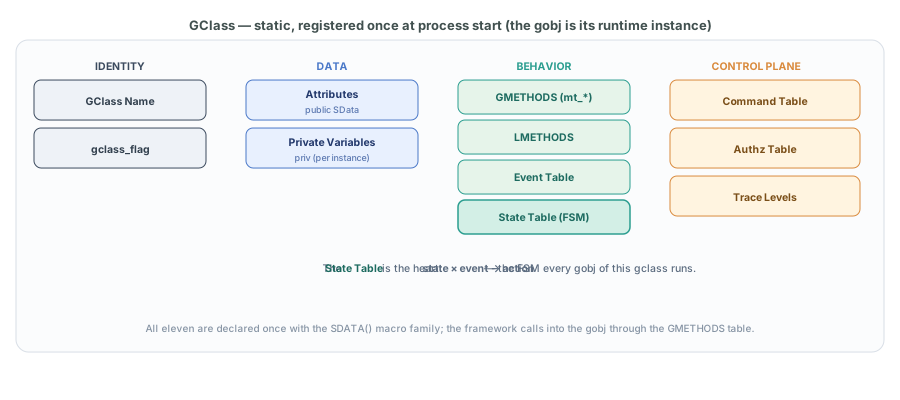
The eleven components, grouped. The State Table (state × event → action) is the FSM every gobj of the gclass runs.
A GClass consists of several key components that define its operation:
Unique name to identify it.
Set of public attributes
Set of private variables
Set of gclass methods that supports
Set of local methods that supports
Set of public and private events.
Set of states with event/actions
Specifies access control rules.
Describes executable commands for the GClass.
Defines trace levels for debugging and monitoring.
Modifier of behavior
How a GClass Works
Definition:
A
GClassis created using thegclass_create()function, combining its attributes, methods, states, events, and other metadata.
Instantiation:
A GObject instance is created from a
GClassusing the GObject API.
Interaction:
The GObject API (for example
gobj_start(),gobj_stop()) dynamically invokes the gclass methods (gmt) defined in theGClass.
Extensibility:
The modular design of
GClassallows new behaviors and features to be added by defining additional methods, events, or states.
Public Interface — what goes in the .h
A GClass is a closed unit. The only symbols its header file exposes are:
GOBJ_DECLARE_GCLASS(C_FOO);
PUBLIC int register_c_foo(void);
That is the entire public surface. Adding raw PUBLIC C functions
to a GClass header — for example a c_foo_get_state(hgobj) accessor
so another module can peek at internal state — is a layering
violation. It bypasses the FSM, the command parser, the authorization
checker, the stats system, and the discoverability provided by
help. It also encourages other modules to reach into the GClass via
raw C calls, which breaks the GClass abstraction.
Everything other code needs to do with a GClass goes through one of five uniform mechanisms:
| Need | Mechanism | Caller API |
|---|---|---|
| Persistent typed state, configurable | Attribute (SDATA in attrs_table) | gobj_read_*_attr() / gobj_write_*_attr() |
| Numeric counter / rate / gauge an operator will chart or reset | Statistic (SDF_STATS / SDF_RSTATS / SDF_PSTATS, or override mt_stats — see parser stats guide) | gobj_stats() |
| Synchronous query or operation, also human-callable | Command (SDATACM in command_table) | gobj_command(). Also reachable via ycommand |
| Asynchronous notification or message flow | Event (entry in event_types[] + states[]) | gobj_send_event() / gobj_publish_event() |
| Tight inter-gobj plumbing without a human use case | Local method (entry in LMETHOD table) | gobj_local_method() |
That uniformity is what makes the framework introspectable from the
agent, controllable from ycommand, and debuggable in production.
Anti-pattern — do not do this in c_foo.h:
GOBJ_DECLARE_GCLASS(C_FOO);
PUBLIC int register_c_foo(void);

/* WRONG: layering violation */
PUBLIC json_t *c_foo_get_state(hgobj gobj);
Correct — expose the same data as a command, callable both from
another GClass via gobj_command() and from a human operator via
ycommand:
/* c_foo.c */
PRIVATE json_t *cmd_view_state(hgobj gobj, const char *cmd, json_t *kw, hgobj src)
{
    PRIVATE_DATA *priv = gobj_priv_data(gobj);
    json_t *jn_data = json_pack(...);  /* the snapshot */
    return msg_iev_build_response(gobj, 0, 0, 0, jn_data, kw);
}

PRIVATE sdata_desc_t command_table[] = {
SDATACM(DTP_SCHEMA, "view-state", a_state, 0, cmd_view_state, "..."),
SDATA_END()
};
/* consumer in another GClass */
json_t *resp = gobj_command(target, "view-state", json_object(), gobj);
json_t *jn_state = kw_get_dict(gobj, resp, "data", NULL, KW_EXTRACT);
JSON_DECREF(resp)
/* use jn_state... */gclass_name_t
The name of the gclass.
Each GClass has a unique name to identify it.
In C must be defined with the macro GOBJ_DEFINE_GCLASS in .c file
and GOBJ_DECLARE_GCLASS in .h file.
Attributes
Attributes in a GClass define its properties or state. They are represented as structured data
of type sdata_desc_t in the attrs_table table, where each entry describes an attribute’s type, access flags, default value, and purpose. Attributes are the foundation of a GClass, providing a schema for configuration, runtime state, and operational behavior.
Key Features of Attributes
1. Data Types
Attributes support various data types. This enables them to store different kinds of information. Common data types include:
String (
DTP_STRING): Textual data.Boolean (
DTP_BOOLEAN): Logical values (trueorfalse).Integer (
DTP_INTEGER): Whole numbers.Real (
DTP_REAL): Floating-point numbers.JSON (
DTP_JSON): JSON objects for structured data.Dictionary (
DTP_DICT): Key-value pairs.Pointer (
DTP_POINTER): References for advanced use cases.
2. Flags
Flags define the access permissions and characteristics of attributes:
Access Control:
SDF_RD: Read-only attributes.SDF_WR: Writable attributes.
Persistence:
SDF_PERSIST: Attributes that are saved and loaded automatically.SDF_VOLATIL: Temporary attributes that are not persisted.
Statistical Data:
SDF_STATS: Attributes holding statistics (read-only).SDF_RSTATS: Resettable statistics.SDF_PSTATS: Persistent statistics.
Authorization:
SDF_AUTHZ_R: Read access requires authorization.SDF_AUTHZ_W: Write access requires authorization.SDF_AUTHZ_X: Execution requires authorization.SDF_AUTHZ_P: Authorization constraint parameter.SDF_AUTHZ_S: Stats read requires authorization.SDF_AUTHZ_RS: Stats reset requires authorization.
3. Default Values
Default values make sure that attributes are initialized with predictable and meaningful data. They are applied when no explicit value is provided during configuration or runtime.
4. Descriptions
Each attribute includes a description that explains its purpose and behavior. Descriptions serve as documentation for developers and users interacting with the GClass.
5. Hierarchical Definitions
Attributes can reference other schemas. This allows for nested and hierarchical data structures. This capability enables complex configurations while maintaining clarity.
Purpose of attrs_table
The attrs_table table serves multiple purposes in a GClass:
Configuration: Defines configurable properties for the GClass.
State Management: Represents the runtime state of an instance.
Validation: Ensures that attributes conform to defined types and constraints.
Access Control: Enforces security policies through flags and authorization mechanisms.
High-Level Overview of Attributes
| Component | Description |
|---|---|
| Type | Specifies the data type of the attribute (for example string, boolean, integer). |
| Name | The unique identifier for the attribute. |
| Flags | Define access permissions and additional properties (for example read-only, persist). |
| Default Value | The initial value of the attribute if none is provided. |
| Description | Explains the purpose and behavior of the attribute. |
Examples of Common Attribute Use Cases
1. Runtime Statistics
Attributes can store real-time statistical data, such as:
Messages transmitted (
txMsgs) and received (rxMsgs).CPU usage (
cpu) and uptime (uptime, seconds since the yuno started).Disk size and free space.
These attributes often use flags like SDF_RD (read-only) and SDF_RSTATS (resettable statistics).
2. Configuration Settings
Attributes can define configurable properties, such as:
timeout: A configurable timeout value.persistent_channels: Whether channels are persistent.deep_trace: Enable or disable detailed tracing.
3. Environment Metadata
Attributes can represent metadata about the GClass or its environment, including:
hostname: The host machine’s name.node_uuid: A unique identifier for the node.realm_id: The identifier for the realm where the GClass operates.
Benefits of Attribute Design with attrs_table
Modularity: Attributes are defined in structured schemas. This makes them reusable and maintainable.
Flexibility: Support for various data types and nested schemas allows for complex configurations.
Validation: Ensures that data conforms to the schema, reducing errors.
Security: Access control flags and authorization paths enforce reliable security policies.
Documentation: Descriptions provide built-in documentation for each attribute.
Finite State Machine
In Yuneta, gobj_state_t and gobj_event_t define the behavior of GObj finite state machines (FSM). This event-driven architecture allows for structured and predictable execution.
gobj_state_t
GObj states represent different stages in an object’s lifecycle, defining how it behaves and responds to events. Each state is identified by a unique name and is used to manage transitions between different operational conditions.
Unique pointer that exposes state names, defined as:
In C:
typedef const char *gobj_state_t;gobj_event_t
GObj events represent actions or signals that trigger transitions between states, facilitating communication between objects. Each event has a specific meaning within the system and determines how a GObj responds to changes or external inputs.
Unique pointer that exposes event names, defined as:
In C:
typedef const char *gobj_event_t;The FSM makes sure of clear behavior and modular event handling.
🛠️ How It Works
State Machine Structure
Each GObj has a state table mapping events to actions:
Event: The event name (
gobj_event_t).Action: The function executed when the event occurs.
Next State: The state transitioned to after execution.
Event Handling
When an event occurs, the FSM:
Checks the current state.
Finds the event in the state table.
Executes the associated action.
Moves to the
next_stateif defined.
Predefined States and Events in the System
Predefined States (gobj_state_t)
The following states are defined in the system using GOBJ_DEFINE_STATE():
ST_DISCONNECTEDST_WAIT_CONNECTEDST_CONNECTEDST_WAIT_TXEDST_WAIT_DISCONNECTEDST_WAIT_STOPPEDST_WAIT_HANDSHAKEST_WAIT_IMEIST_WAIT_IDST_STOPPEDST_SESSIONST_IDLEST_WAIT_RESPONSEST_OPENEDST_CLOSEDST_WAITING_HANDSHAKEST_WAITING_FRAME_HEADERST_WAITING_PAYLOAD_DATA
Predefined Events (gobj_event_t)
The following events are defined in the system using GOBJ_DEFINE_EVENT():
EV_TIMEOUTEV_TIMEOUT_PERIODICEV_STATE_CHANGEDEV_SEND_MESSAGEEV_SEND_IEVEV_SEND_EMAILEV_DROPEV_ON_OPENEV_ON_CLOSEEV_ON_MESSAGE(withGBuffer)EV_ON_COMMANDEV_ON_IEV_MESSAGE(withIEvent, oldEV_IEV_MESSAGE)EV_ON_IDEV_ON_ID_NAKEV_ON_HEADEREV_HTTP_MESSAGEEV_CONNECTEV_CONNECTEDEV_DISCONNECTEV_DISCONNECTEDEV_RX_DATAEV_TX_DATAEV_TX_READYEV_STOPPED
These events represent system signals for timeouts, state transitions, messaging, connection handling, and data transmission. They trigger actions within the system. This allows GObjs to react to external stimuli, manage their internal state, and make possible communication between different components.
These predefined states and events form the core of Yuneta’s GObj framework. This enables structured event-driven programming and state management. States define the behavior of an object at any given time, while events act as triggers that drive transitions between these states. Together, they create a dynamic and responsive system that efficiently handles various operational scenarios.
EV_STATE_CHANGED
Is a system event. Publish when a FSM change his state.
Private Attributes
Private attributes, they are implemented accord the language
GMETHODS
The GMETHODS structure in Yuneta defines the gclass methods that a GClass can implement. These methods encapsulate key behaviors and operations associated with the lifecycle, state management, and function of GObjects.
Each method serves a specific purpose and is invoked through the GObject API. This enables dynamic and modular behavior across different GClasses.
The GMETHODS structure enables flexible, modular behavior in the Yuneta framework. Each method is optional. This allows GClasses to implement only the function they need.
Methods
mt_create:Purpose: Initializes the GObject. Called when a GObject is instantiated.
Example: Allocating memory or setting default attribute values.
mt_create2:Purpose: Provides extended initialization capabilities with additional parameters.
Example: Custom initialization logic based on specific input.
mt_destroy:Purpose: Cleans up and destroys the GObject. Called when the GObject is deleted.
Example: Freeing resources or stopping child GObjects.
mt_start:Purpose: Starts the operation of the GObject.
Example: Transitioning to a running state or starting timers.
mt_stop:Purpose: Stops the operation of the GObject.
Example: Halting operations, stopping timers, or freeing temporary resources.
mt_play:Purpose: Resumes the GObject’s operation after being paused.
Example: Resuming services or processes.
mt_pause:Purpose: Pauses the GObject’s operation.
Example: Temporarily halting services without stopping them.
mt_writing:Purpose: Handles attribute write operations dynamically.
Example: Validating or processing the value being written.
mt_reading:Purpose: Handles attribute read operations dynamically.
Example: Adjusting or filtering the value before returning it.
mt_subscription_added:Purpose: Called when a subscription to an event is added.
Example: Managing event listeners or counting subscriptions.
mt_subscription_deleted:Purpose: Called when a subscription to an event is removed.
Example: Cleaning up resources or notifying other components.
mt_child_added:Purpose: Called after a child GObject is created and added.
Example: Managing hierarchical relationships.
mt_child_removed:Purpose: Called before a child GObject is removed.
Example: Cleaning up references or handling dependencies.
mt_stats:Purpose: Returns statistics related to the GObject in a JSON format.
Example: Providing performance or usage metrics.
mt_command_parser:Purpose: Parses and executes user commands specific to the GClass.
Example: Implementing custom command handling logic.
mt_inject_event:Purpose: Handles events manually, bypassing the built-in state machine.
Example: Custom event-processing logic.
Purpose: Creates a new resource managed by the GObject.
Example: Initializing data structures or external dependencies.
Purpose: Lists resources managed by the GObject.
Example: Returning an iterator or JSON representation.
Purpose: Saves or updates a resource.
Example: Persisting data to storage.
Purpose: Deletes a resource.
Example: Removing an entry from a database.
mt_state_changed:Purpose: Handles transitions between states.
Example: Logging state changes or triggering side effects.
Purpose: Authenticates users or services.
Example: Verifying credentials or tokens.
mt_list_children:Purpose: Lists the child GObjects of the current GObject.
Example: Returning hierarchical information.
mt_stats_updated:Purpose: Notifies that statistics were updated.
Example: Refreshing metrics in real time.
Purpose: Disables the GObject.
Example: Preventing further operations until re-enabled.
Purpose: Enables the GObject.
Example: Allowing operations after being disabled.
mt_trace_on:Purpose: Enables tracing for the GObject.
Example: Activating debug or log output.
mt_trace_off:Purpose: Disables tracing for the GObject.
Example: Deactivating debug or log output.
mt_gobj_created:Purpose: Special method invoked when a GObject is created. Typically for the root object (
__yuno__).Example: Custom initialization for the Yuno.
mt_publish_event:Purpose: Manages the publication of events.
Example: Filtering or modifying events before they are emitted.
mt_authz_checker:Purpose: Checks authorization for specific actions or events.
Example: Enforcing access control policies.
Purpose: Methods for managing nodes in TreeDB.
Example: Adding, updating, deleting, or linking nodes.
Purpose: Methods for managing nodes in TreeDB.
Example: Adding, updating, deleting, or linking nodes.
Purpose: Methods for managing nodes in TreeDB.
Example: Adding, updating, deleting, or linking nodes.
Purpose: Methods for managing nodes in TreeDB.
Example: Adding, updating, deleting, or linking nodes.
Purpose: Methods for managing nodes in TreeDB.
Example: Adding, updating, deleting, or linking nodes.
Purpose: Methods for inspecting TreeDB topics.
Example: Describing topics or retrieving metadata.
Purpose: Methods for inspecting TreeDB topics.
Example: Describing topics or retrieving metadata.
Purpose: Methods for inspecting TreeDB topics.
Example: Describing topics or retrieving metadata.
mt_topic_size:Purpose: Methods for inspecting TreeDB topics.
Example: Describing topics or retrieving metadata.
Purpose: Manage snapshots in the TreeDB.
Example: Creating or restoring data snapshots.
Purpose: Manage snapshots in the TreeDB.
Example: Creating or restoring data snapshots.
Purpose: Manage snapshots in the TreeDB.
Example: Creating or restoring data snapshots.
Mapping
This section maps GObject API functions to the GMETHODS they invoke. It provides a detailed overview of how GMETHODS are used within the GObject lifecycle.
This mapping provides a detailed and structured view of how GMETHODS are used across various GObject API functions, covering attributes, events, TreeDB, lifecycle, and more. Each method plays a specific role in the modular design of the GClass.
Creation and Destruction
Creation Operations:
gobj_create2():mt_create2: Initializes the GObject with additional parameters.mt_create: Performs basic GObject initialization.mt_child_added: Invoked when a child GObject is added.mt_gobj_created: Special handling for__yuno__when a GObject is created.
Destroy Operations:
gobj_destroy():mt_child_removed: Invoked when a child GObject is removed.mt_destroy: Cleans up resources when a GObject is destroyed.
Attribute Management
Read Operations:
gobj_read_bool_attr():gobj_read_integer_attr():gobj_read_str_attr():gobj_read_pointer_attr():mt_reading: Retrieves the requested attribute dynamically.
Write Operations:
gobj_write_str_attr():gobj_write_bool_attr():gobj_write_integer_attr():mt_writing: Updates the specified attribute dynamically.
Lifecycle Management
gobj_start():mt_start: Starts the GObject’s operation.
gobj_stop():mt_stop: Stops the GObject’s operation.
gobj_play():mt_play: Resumes the GObject after being paused.
gobj_pause():mt_pause: Pauses the GObject’s operation.
mt_disable: Disables the GObject.
mt_enable: Enables the GObject.
Event and State Management
gobj_send_event():mt_inject_event: Processes an event directly.
gobj_change_state():mt_state_changed: Handles state transitions.
Subscription Management
gobj_subscribe_event():mt_subscription_added: Called when a subscription is added.
_delete_subscription():mt_subscription_deleted: Called when a subscription is removed.
Resource Management
mt_create_resource: Called when a resource is created.
mt_save_resource: Called when a resource is saved.
mt_delete_resource: Called when a resource is deleted.
mt_list_resource: Called when a resource is list.
mt_get_resource: Called when a resource is get.
Publishing Events
gobj_publish_event():mt_publish_event: Manages the publication of events.mt_publication_pre_filter: Applies pre-filters to events before publishing.mt_publication_filter: Filters events before final publishing.
Commands and Statistics
gobj_command():mt_command_parser: Executes a command related to the GClass.
gobj_stats():mt_stats: Provides statistics for the GObject.
Authorization
mt_authz_checker: Verifies if the user has the necessary permissions.
TreeDB Management
mt_treedbs: Lists the TreeDBs associated with the GObject.
mt_treedb_topics: Lists the topics within a TreeDB.
mt_topic_desc: Describes a topic in the TreeDB.
mt_topic_links: Lists the links for a topic.
mt_topic_hooks: Lists the hooks for a topic.
mt_create_node: Creates a new node in the TreeDB.
mt_update_node: Updates an existing node in the TreeDB.
mt_delete_node: Deletes a node from the TreeDB.
mt_get_node: Retrieves a specific node.
mt_list_nodes: Lists all nodes in a topic.
mt_list_instances: Lists instances of nodes.
mt_node_parents: Lists the parent nodes of a specific node.
mt_node_children: Lists the child nodes of a specific node.
mt_topic_jtree: Retrieves the JSON representation of a topic’s tree structure.
mt_node_tree: Retrieves the tree structure of nodes.
Snapshots
mt_shoot_snap: Creates a snapshot.
mt_activate_snap: Activates a snapshot.
mt_list_snaps: Lists all snapshots.
Tracing
mt_trace_on: Enables tracing for the GObject.mt_trace_off: Disables tracing for the GObject.
LMETHOD
The LMETHOD structure in the Yuneta framework defines the local methods
that can be implemented by a GClass.
These methods are specific to the internal operation of the GClass
and are not intended to be invoked dynamically via
the gobj_local_method() API,
unlike the gclass methods (GMETHODS).
Event Table
A list of public and private events that the
GClasscan handle or emit.Events are categorized with flags, such as
EVF_OUTPUT_EVENT.
In C:
typedef struct event_type_s {
    gobj_event_t event;
    event_flag_t event_flag;
} event_type_t;
States Table
Defines the behavior of the GClass in terms of states, events, and transitions:
- States: Predefined states (for example ST_CLOSED, ST_OPENED).
Events: Triggers for state transitions (for example
EV_ON_OPEN,EV_ON_CLOSE).Actions: Functions executed during transitions between states.
In C:
typedef struct states_s {
    gobj_state_t state_name;
    ev_action_t *state;
} states_t;Authorizations
The authz_table in a GClass defines the permissions required to access specific operations or resources. Each entry in the authz_table describes a distinct authorization, including its parameters, description, and validation schema. The authz_table is implemented using sdata_desc_t structures.
Key Features of Authorizations
1. Authorization Levels
Each authorization defines a level or type of access, such as:
create: Permission to create resources.update: Permission to modify existing resources.read: Permission to view resources.delete: Permission to remove resources.
2. Validation Parameters
Each authorization level can specify a schema that describes the parameters required for validation. For example:
Parameters can include resource names, IDs, or paths.
Parameters can reference specific authorization paths (for example
"recordid"`).
3. Authorization Paths
Authorization paths define the logic for validating access. Paths can:
Point to specific fields or metadata within a resource (for example
"__md_treedb__treedb_name"`).Be empty (
"") for unrestricted or default access.
4. Descriptions
Each authorization includes a description that clearly defines its purpose. These descriptions serve as documentation and help developers and administrators understand the access requirements.
Purpose of authz_table
The authz_table enforces access control within a GClass. By defining and validating authorizations, the GClass makes sure that operations are performed only by users or systems with the necessary permissions.
Validation of Authorizations
The authz_table works with APIs like gobj_user_has_authz to validate permissions dynamically. These APIs:
Check if the current user or system has the required authorization.
Validate the input parameters against the schema defined for the authorization.
Respond with an appropriate error or success message.
High-Level Process
Permission Check: Specify the desired permission (for example
"create").Validation: The
gobj_user_has_authzfunction validates the authorization based on:
The current user’s roles and permissions.
The input parameters provided to the function.
The schema and paths defined in the
authz_table.
Action Execution: If the validation passes, the requested action is performed. Otherwise, an error is returned.
Benefits of authz_table
Granular Access Control: Permissions can be tailored for specific actions and resources.
Validation and Consistency: Using schemas makes sure that authorization checks are structured and reliable.
Reusability: Authorization definitions can be reused across different operations or resources within a GClass.
Security: Centralized definitions minimize the risk of unauthorized access.
Example Use Cases
Authorization Levels
Create: Permission to add new nodes or resources.
Update: Permission to modify existing data.
Read: Permission to view specific data.
Delete: Permission to remove resources.
Parameterized Authorizations
Authorizations can specify required parameters, such as resource names, IDs, or metadata paths, for validation.
For example, a
readpermission can require atreedb_nameandidto validate access to a specific node.
Command Table
The command_table in a GClass defines the available commands and their corresponding behaviors. Each command is represented as an entry in the table, described with parameters, aliases, execution logic, and a human-readable description. This structured approach makes sure of consistency, flexibility, and clarity in how commands are defined and executed.
Key Features of Commands
1. Command Names
Each command is identified by a unique name, which is used to invoke the command programmatically. For example:
help: Provides help or documentation for available commands.view-channels: Displays the current status of channels.reset-stats-channel: Resets statistics for a specific channel.
2. Aliases
Commands can have alternative names (aliases) to provide flexibility and improve usability. For instance:
The
helpcommand can have aliases likehor?.
3. Parameters
Commands accept structured input, described using schemas. These schemas are defined in sdata_desc_t tables, specifying:
Parameter Name: The name of the input parameter.
Type: The type of the parameter (for example string, boolean, integer).
Flags: Attributes of the parameter, such as required or optional.
Default Value: The default value for the parameter if none is provided.
Description: A description of the parameter’s purpose.
4. Handlers
Each command is linked to a function that implements its logic. These handler functions:
Receive the command name and input parameters.
Perform the intended operation or behavior.
Return results or error messages.
5. Descriptions
Commands include a detailed description to document their purpose and function. This description is useful for both users and developers.
Purpose of command_table
The command_table serves as a central registry for all commands available in a GClass. It provides:
Consistency: All commands are defined in a structured and uniform manner.
Validation: Ensures that commands receive the expected input, conforming to their schemas.
Documentation: Built-in descriptions make commands self-explanatory.
Flexibility: Commands can be extended, updated, or aliased without altering the overall structure.
High-Level Overview of Command Definitions
| Component | Description |
|---|---|
| Command Name | The unique identifier for the command. |
| Aliases | Alternative names for the command, improving usability. |
| Parameters | Input schema defining the required and optional parameters for the command. |
| Handler Function | A function that implements the command’s logic. |
| Description | Documentation describing the command’s purpose and behavior. |
Benefits of command_table
Extensibility: Commands can be added, removed, or modified without affecting other components.
Reusability: Shared schemas allow commands to reuse parameter definitions across multiple commands.
Validation: Input parameters are rigorously validated using predefined schemas.
Self-Documentation: Command descriptions and aliases make the system intuitive for users and developers.
Integration: Commands are integrated with authorization and other components of the GClass.
Trace Levels
Trace levels allow precise control over debugging and diagnostic logging in a GClass. By defining a table of trace levels (s_user_trace_level), GClasses can manage which aspects of their behavior are logged. This makes sure of detailed, yet efficient, monitoring and debugging.
In C:
typedef struct {
    const char *name;
    const char *description;
} trace_level_t;
Key Concepts
Trace Level Table (s_user_trace_level)
The trace level table defines all available trace levels for a GClass. Each entry in the table includes:
Name: A unique identifier for the trace level.
Description: A detailed explanation of what the trace level represents.
Managing Trace Levels with GObj API
Trace levels are dynamically managed using the GObj API. These functions allow for:
Retrieving lists of active trace levels.
Setting or clearing specific trace levels at the global, GClass, or GObj instance levels.
Checking if specific trace levels are active.
Core API Functions
1. Listing Trace Levels
Retrieve the list of all defined trace levels for a GClass:
gobj_trace_level_list(hgclass gclass): Returns a JSON list of all trace levels defined in the GClass.
2. Retrieving Active Trace Levels
Retrieve the currently active trace levels at various scopes:
Global Levels:
gobj_get_global_trace_level(): Get active global trace levels.
GClass Levels:
gobj_get_gclass_trace_level(hgclass gclass): Get active trace levels for a GClass.gobj_get_gclass_trace_no_level(hgclass gclass): Get trace levels explicitly disabled for a GClass.
GObj Instance Levels:
gobj_get_gobj_trace_level(hgobj gobj): Get active trace levels for a GObj instance.gobj_get_gobj_trace_no_level(hgobj gobj): Get trace levels explicitly disabled for a GObj instance.
3. Tree and Hierarchy Retrieval
Retrieve trace levels across hierarchical scopes:
gobj_get_gclass_trace_level_list(hgclass gclass): Get active trace levels for a GClass and its hierarchy.gobj_get_gobj_trace_level_tree(hgobj gobj): Get active trace levels for a GObj and its tree of children.
4. Querying and Checking Trace Levels
Query specific trace levels for a GObj instance:
gobj_trace_level(hgobj gobj): Retrieve the active trace level bitmask for a GObj.is_level_tracing(hgobj gobj, uint32_t level): Check if a specific trace level is active.is_level_not_tracing(hgobj gobj, uint32_t level): Check if a specific trace level is explicitly disabled.
5. Setting Trace Levels
Enable or disable trace levels dynamically at different scopes:
Global Scope:
gobj_set_global_trace(const char *level, BOOL set): Enable or disable specific global trace levels.gobj_set_global_no_trace(const char *level, BOOL set): Enable or disable “no trace” levels globally.
GClass Scope:
gobj_set_gclass_trace(hgclass gclass, const char *level, BOOL set): Enable or disable trace levels for a GClass.
GObj Instance Scope:
gobj_set_gobj_trace(hgobj gobj, const char *level, BOOL set, json_t *kw): Enable or disable trace levels for a specific GObj instance.
6. Deep Tracing
Deep tracing enables comprehensive logging across all levels:
gobj_set_deep_tracing(int level): Enable deep tracing with different levels of detail.gobj_get_deep_tracing(): Retrieve the current deep tracing level.
Practical Use Cases
1. Dynamic Logging
During runtime, trace levels can be toggled on or off to focus on specific areas, such as:
Connections (
connections).Traffic (
traffic).Security (
tls).
This dynamic control reduces log clutter and enhances debugging efficiency.
2. Debugging Hierarchies
Trace levels can propagate across GClass and GObj hierarchies. For instance:
Enabling a trace level for a parent GClass or GObj can cascade to its children.
Hierarchical queries can retrieve active trace levels across an entire tree of objects.
3. Selective Analysis
Trace levels allow selective analysis of specific features or operations, improving troubleshooting accuracy. For example:
Checking only traffic logs when debugging data flow issues.
Enabling TLS logs during secure connection debugging.
Benefits of Trace Levels
Granular Control: Enable or disable logging for specific features or behaviors.
Dynamic Configuration: Adjust trace levels at runtime without restarting the application.
Hierarchical Flexibility: Manage trace levels across global, GClass, and GObj scopes.
Efficiency: Minimize performance impact by logging only relevant details.
Clarity: Descriptive trace level names and documentation improve usability.
gclass_flag_t
The gclass_flag_t enumeration defines flags that can be applied to a GClass to modify its behavior. These flags are used to control specific operational aspects of the GClass.
Values of gclass_flag_t Flags
gcflag_manual_start: (0x0001)Description: Prevents the automatic start of the GObject tree. When this flag is set,
gobj_start_tree()will not start the GObject automatically.Use Case: Manual control over when a GObject tree is started.
gcflag_no_check_output_events: (0x0002)Description: Disables output event checking. When publishing events, it skips validation against the
output_event_list.Use Case: Optimization when output event checking is unnecessary.
gcflag_ignore_unknown_attrs: (0x0004)Description: Allows the creation of a GObject even if it contains attributes that are not defined in the
GClass.Use Case: Flexibility during dynamic object creation when unknown attributes can be present.
gcflag_required_start_to_play: (0x0008)Description: Prevents the GObject from entering the “play” state unless it has already been started.
Use Case: Ensures proper initialization before transitioning to “play.”
gcflag_singleton: (0x0010)Description: Enforces that only one instance of the
GClasscan exist at a time.Use Case: For
GClassesthat must maintain a single-instance constraint (for example a singleton pattern).
Error Handling Convention — No Silent Errors
In Yuneta, the log is the only window into runtime failures.
Production debugging starts and ends with gobj_log_error and the
trace levels — there is no other observability surface for the C
side. Any error path that returns without leaving a trace is a blind
spot.
The convention is enforced by reading code, not by the compiler:
Every path that returns an error indicator (
-1,NULL,FALSE, an error sentinel) MUST do one of two things — no exceptions:
Call
gobj_log_error()immediately before thereturn, with the standard fields (function,msgset,msg, plus relevant context attributes).If the failure was already logged by the helper that produced it (typical when calling functions with a
verbose=TRUE/KW_REQUIREDflag —gobj_find_service("name", TRUE),kw_get_*withKW_REQUIRED,gobj_create_*on failure, …), write// Error already loggedon its own line right above thereturn.
The annotation in case 2 is mandatory, not optional. A bare
if(!x) return -1; with no log and no comment is a defect to fix,
not a stylistic choice. The comment exists so the next reader can
tell intentional silence apart from a forgotten trace.
Example — already logged inside the helper
priv->gobj_bff_side = gobj_find_service("__bff_side__", TRUE);
if(!priv->gobj_bff_side) {
    // Error already logged
    return -1;
}
Here gobj_find_service was called with verbose=TRUE, which makes
the helper itself emit a gobj_log_error on miss. Logging again
will be noise. The comment proves the silence is intentional.
Example — direct logging at the point of failure
const char *url = gobj_read_str_attr(gobj, "url");
if(empty_string(url)) {
    gobj_log_error(gobj, 0,
        "function",     "%s", __FUNCTION__,
        "msgset",       "%s", MSGSET_PARAMETER,
        "msg",          "%s", "url EMPTY",
        NULL
    );
    return -1;
}
Validation, allocation failures, business-logic violations and
syscalls without their own logging fall into this category. Always
include enough context attributes (gobj, function, the offending
input, the attempted operation) so the message is actionable on its
own.
When reviewing existing code
Treat untraced error returns as fixable defects, not as background noise. Adding the missing log or annotation as part of an unrelated change is the right thing to do — it pays observability debt with zero risk.
__global_list_persistent_attrs_fn__
A process-global callback that backs
gobj_list_persistent_attrs().
It is one of the persistent-attribute hooks installed at boot by gobj_start_up()
— the list field of the persistent_attrs_t struct, alongside startup,
end, load, save, and remove:
typedef json_t *(*list_persistent_attrs_fn)(hgobj gobj, json_t *keys /* owned */);When set, it returns the persistent attributes currently stored for gobj (or
for every service when gobj is NULL). When it is not set — the default
when the application installs no persistence backend — gobj_list_persistent_attrs()
returns an empty JSON object.