Read this first. Everything else under Operating Yuneta assumes you already know what
main()does, who is the parent of who, and why a yuno survives akill -9of its agent.
A yuno is an autonomous machine. It is engineered to keep running with
or without an agent on the box. The agent is one more peer in the ecosystem
— a manager, not a parent. The mechanism that makes that autonomy concrete
lives in two files of kernel/c/root-linux/src/:
| File | Role |
|---|---|
entry_point.c | The int main() body every yuno calls. argp, gbmem, config, log, gobj_start_up, registration, then either daemon or foreground. |
ydaemon.c | The supervision kernel under --start. Double fork, watcher process, auto-relaunch on abnormal exit. |
Every standalone or citizen yuno’s main.c boils down to one call to
yuneta_entry_point() (optionally preceded by yuneta_setup() if it wants
to override defaults). See yunos/c/yuno_agent/src/main.c for the
canonical example.
1. The picture¶
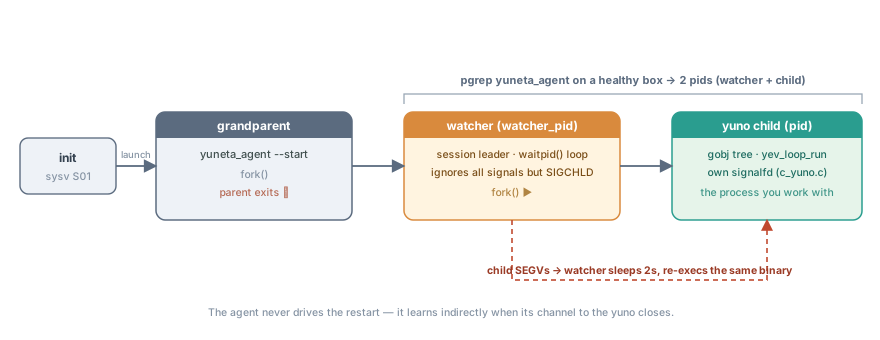
The same picture in text:
                 ┌─────────────────────────────────────────┐
init / sysv ──►  │ grandparent: yuneta_agent --start       │
                 │   fork()  ── parent exits ──►           │
                 │   ┌─────────────────────────────────────┤
                 │   │ watcher (session leader, watcher_pid)
                 │   │   waitpid() loop, ignores all signals except SIGCHLD
                 │   │   fork()  ──►                        │
                 │   │   ┌─────────────────────────────────┤
                 │   │   │ yuno child (pid)                 │
                 │   │   │   gobj tree, yev_loop_run        │
                 │   │   │   own signalfd handler (c_yuno.c)│
                 │   │   └─────────────────────────────────┘
                 └─────────────────────────────────────────┘
Two implications worth keeping in your head:
Every yuno you see in
pshas a sibling watcher.pgrep yuneta_agenton a healthy box returns two pids: the watcher and the child.The watcher does not know what the agent is. It uses
waitpid()on one specific pid. If the child SEGVs, the watcher sleeps 2s and re-execs the same binary with the same args. The agent is informed indirectly (its channel to the yuno closes). It does not drive the restart.
2. yuneta_setup() — pluggable defaults (optional)¶
Call before yuneta_entry_point() if you want to override any of:
| Knob | Default | Where the default is set |
|---|---|---|
persistent_attrs | db_load/save/remove/list_persistent_attrs (dbsimple) | entry_point.c |
command_parser | internal command_parser() | entry_point.c |
stats_parser | internal stats_parser() | entry_point.c |
authz_checker | C_AUTHZ monoclass checker | entry_point.c |
authentication_parser | C_AUTHZ parser | entry_point.c |
MEM_MIN_BLOCK / MEM_MAX_BLOCK | 512 B / 16 MiB | entry_point.c |
MEM_SUPERBLOCK | 16 MiB | entry_point.c |
MEM_MAX_SYSTEM_MEMORY | 64 MiB | entry_point.c |
USE_OWN_SYSTEM_MEMORY | FALSE (use libc malloc under gbmem) | entry_point.c |
The memory tunables are passed straight to gbmem_setup() later. Yunos
that handle large messages (image proxies, mqtt brokers under load) bump
MEM_MAX_BLOCK and MEM_MAX_SYSTEM_MEMORY. See yuno_agent/src/main.c
for a representative call site.
3. yuneta_entry_point() — the choreography¶
entry_point.c. In execution order:
3.1 Identity sanity¶
APP_NAMEmust be ≤ 15 chars (Linuxcommfield limit). Test binaries starting withtest_are exempted (PREFIX_TEST_APP— flagged as a BUG in the source itself).The Unix user running the binary must be
yunetaor in groupyuneta, otherwiseprint_error(PEF_EXIT, …).
3.2 argp¶
| Flag | Effect |
|---|---|
-S, --start | Run as daemon (double-fork + watcher). Else foreground. |
-K, --stop | Call daemon_shutdown(process_name) and exit (see §4.5). |
--pid-file=FILE | With --start: write the WATCHER’s pid in FILE before returning (see §4.7). |
-f, --config-file=FILE | Merge external JSON on top of fixed/variable config. |
-p, --print-config | Print final merged config and exit. |
-P, --print-verbose-config | Print config with all defaults expanded and exit. |
-r, --print-role | Print {role,name,alias,version,date,description,tags,…} and exit. |
-v, --version | Print yuno version and exit. |
-V, --yuneta-version | Print yuneta runtime version and exit. |
-l, --verbose-log=N | Override handler_options of the stdout log handler. Not a trace switch — it only selects which fields each line prints. |
-g, --global-trace=LEVEL | Enable a global trace level before the first service starts. Repeatable and comma-separated. list prints the available levels. The only way to trace start up itself, since set-global-trace needs the agent channel that a failing yuno never opens. See DEBUGGING.md §4.1. |
3.3 Close-and-rewire stdio in daemon mode¶
With --start, the framework closes every fd in
[0, sysconf(_SC_OPEN_MAX)). Then it opens /dev/null to take fd 0, and
calls dup2 for fd 1 and fd 2. After this, no inherited fd survives.
check_open_fds() warns if anything stays open beyond 4.
3.4 Allocator switch — this is load-bearing¶
gbmem_get_allocators(&malloc, &realloc, &calloc, &free);
json_set_alloc_funcs(malloc_func, free_func);     // jansson now uses gbmem
gbmem_setup(MEM_MAX_BLOCK, MEM_MAX_SYSTEM_MEMORY, USE_OWN_SYSTEM_MEMORY,
            MEM_MIN_BLOCK, MEM_SUPERBLOCK);
After this line, every json_* allocation goes through gbmem_* and is
tracked under CONFIG_DEBUG_TRACK_MEMORY.
Test-author trap: any json_pack() / set_expected_results() called
before yuneta_entry_point returns gets libc-tracked memory that
gbmem cannot free later → false leaks. Put that setup inside
register_yuno_and_more() (which runs at §3.10 below), never in main().
See memory feedback_test_json_allocator_timing.
3.5 Logging boot¶
glog_init() registers the available log handler types (stdout, file,
udp). rotatory_start_up() arms the rotation timer. No handlers are
attached yet.
3.6 Merge the config¶
json_config() merges, in order:
fixed_config (compiled into the yuno) +
variable_config (compiled, intended to be overridden) +
--config-file=… contents +
[json blob passed as argp positional argument]
view-config on a running yuno (ycommand command-yuno id=<id> service=__yuno__ command=view-config) returns this merged result, not
the on-disk file. See memory feedback_yuno_runtime_config.
3.7 Environment registration¶
Reads environment.{work_dir, domain_dir, xpermission, rpermission} from
the merged config and calls register_yuneta_environment(). This is what
later powers yuneta_realm_file(), yuneta_log_file() and the rest of
the path helpers.
3.8 gobj_start_up()¶
Initializes the gobj registry, persistent-attrs subsystem, the four
parsers (command/stats/authz/authentication) and the trace plumbing. From
here on, gobj_create*/gobj_log_*/gobj_subscribe_event are usable.
3.9 Log handlers — files and UDP¶
Reads environment.{daemon|console}_log_handlers depending on
__as_daemon__. For each entry:
handler_type: stdout→ attaches withhandler_options(overridable with-l).handler_type: file→ opens a rotatory at the path resolved byyuneta_log_file(), honouringbf_size,max_megas_rotatoryfile_size,min_free_disk_percentage.handler_type: udp(or legacy typoupd) →udpc_open()to the configuredurl. This is the logcenter feed.
3.10 Register gclasses¶
result += yunetas_register_c_core();   // runtime gclasses (c_tcp, c_timer, …)
result += register_yuno_and_more();    // the yuno's own gclasses + setup
register_yuno_and_more() runs after environment + gobj_start_up are
ready, but before any service or yuno gobj is created. This is the
canonical place to:
gobj_register_gclass(…)your own classes,enable traces from code,
in tests,
set_expected_results()(see §3.4).
3.11 Branch on daemon mode¶
if(__as_daemon__) {
    daemon_run(process, process_name, work_dir, domain_dir, cleaning_fn);
    return gobj_get_exit_code();
} else {
    process(process_name, work_dir, domain_dir, cleaning_fn);
    return result;
}
The foreground path runs process() directly. The daemon path goes
through ydaemon.c. Both paths reach the same process() function.
4. ydaemon.c — the supervision kernel¶
ydaemon.c. The reason a yuno survives kill -9 yuneta_agent.
4.1 Double fork¶
continue_as_daemon(): fork() once. The parent calls
_exit(EXIT_SUCCESS). The child becomes session leader via setsid() and
records watcher_pid = getpid(). This is the watcher process.
relauncher(): fork() again. The watcher waitpid()s on
the grandchild, and the grandchild is the actual yuno. The grandchild
inherits umask 0, chdirs to work_dir, and calls process().
4.2 Watcher signal posture¶
signal(SIGPIPE, SIG_IGN);
signal(SIGTERM, SIG_IGN);
signal(SIGALRM, SIG_IGN);
signal(SIGINT,  SIG_IGN);     // ctrl+c
signal(SIGUSR1, SIG_IGN);
signal(SIGUSR2, SIG_IGN);
sigaction(SIGQUIT, {on_watcher_sigquit, SA_RESTART});   // notes the stop
The watcher is deliberately deaf to everything except SIGCHLD (delivered
implicitly via waitpid), SIGKILL (uncatchable, terminates it) and
SIGQUIT, which does not end it: it notes the stop, and the child that ends
after it is not relaunched, whatever its end (SA_RESTART keeps the
waitpid() going). Up to 7.25.22 SIGQUIT was ignored too, and an agent that
crashed during its orderly stop was relaunched 2 s later.
4.3 waitpid() decision matrix¶
Event reported by waitpid() | Watcher action |
|---|---|
WIFEXITED && exit_code == 0 | return 1 → exit (no relaunch) |
WIFEXITED && exit_code != 0 | return -1 → sleep(2) + relaunch |
WIFSIGNALED && signal == SIGKILL | return 1 → exit (no relaunch) |
WIFSIGNALED && signal != SIGKILL (SEGV…) | return -1 → sleep(2) + relaunch |
| anything else | return -1 → relaunch |
relaunch_times is bumped on every restart and logged with:
MSGSET_SYSTEM "Daemon relaunched" process=… pid=… relaunch_times=… signal_code=… exit_code=…That log line is the only indication a watcher resurrection happened.
If you see relaunch_times > 0 after a quiet day, something crashed.
4.4 What the agent does and does not do¶
Auto-restart on crash is the watcher’s job, not the agent’s.
The agent sees a closed channel (
EV_ON_CLOSE) when the yuno child dies — but the agent’s record-clear and the watcher’s relaunch run in parallel and are unrelated. By the time the agent reconciles, the watcher has already spawned a new yuno child with a new pid.If you
kill -9the agent itself, every yuno on the box keeps running. Each one still has its watcher. Restarting the agent re-discovers them viagetpgid(pid) >= 0checks plus the boot-timerun_enabled_yunos().
4.5 --stop / daemon_shutdown()¶
daemon_shutdown() scans /proc/*/comm for entries matching
process_name that were started as it (the base name of argv[0] in
/proc/<pid>/cmdline, readable whoever owns the process: the SysV script of
the same name has its interpreter there, /bin/sh, and is not one of them;
an agent whose binary was renamed or replaced on disk still is; a zombie of
the name is dead: it is not taken, and an EPERM on one is no failure; the
list has no fixed size, so look-alikes of the name, which anybody can start,
cannot crowd the real ones out of it), sends
SIGQUIT to every one of them -- the watchers first (a
process whose parent is not of the name), so none relaunches its child --,
gives them 10 s to be gone (looked at every 100 ms), then scans again and
kills with SIGKILL what is still there:
kill(watcher, SIGQUIT);                     // first: it will not relaunch
kill(child, SIGQUIT);                       // soft exit, let it delete pid file, flush logs
wait_until = start_msectimer(STOP_WAIT_MS); // 10 s for all of them
...                                         // every 100 ms: gone, or a zombie?
search_process(name, ...);                  // again: what is left, relaunched or not
kill(pid, SIGKILL);                         // guarantee they go
Every kill() is checked: one that fails (another user’s agent: EPERM)
is said on stderr, not waited for, and --stop exits 1. Up to 7.25.22 none
was checked: an EPERM waited 10 s, printed “killed (SIGKILL)” and exited
0; and an agent that crashed during its stop was relaunched by its watcher,
the watcher was SIGKILLed at 10 s, and the new agent was left an orphan.
Up to 7.25.21 each process was killed 1 s after its own SIGQUIT, one after the other: the agent had one second for its orderly shutdown, and the watcher, deaf to SIGQUIT, always took its whole second.
The scan matches both processes of the pair, because the watcher and the child share the process name. Each one answers differently:
The child catches SIGQUIT through its signalfd and calls
set_yuno_must_die(), which setsgobj_set_exit_code(0)before the orderly shutdown. So it exits 0 — and per the matrix in §4.3 the watcher then returns 1 and exits by itself. A SIGQUIT does not leave a resurrecting yuno behind.The watcher notes SIGQUIT (§4.2) and stays in its
waitpid(): when the child ends, it exits instead of relaunching it, even if the child crashed in its shutdown.
The SIGKILL is therefore not what breaks a relaunch loop: it is the
guarantee for the case where 10 s were not enough — a child stuck in its
shutdown, and the watcher still sitting in waitpid(). SIGKILL is uncatchable
and takes both; --stop says so on stderr (“still alive after the wait:
killed (SIGKILL)”, or “started while the stop ran” for a process of the
name that was not in the first scan).
That exit code is the whole protocol. The restart path uses the other value:
timeout_restart sets gobj_set_exit_code(-1), and the non-zero exit is
precisely what asks the watcher to launch the yuno again.
4.6 get_watcher_pid()¶
Exported so c_yuno.c can include both pid and watcher_pid in the
yuno’s identity card. That is how the agent gets the yuno_pid and the
watcher_pid rows in its treedb (used by kill-yuno, see §7).
4.7 Under a systemd unit: --pid-file¶
The agents run under native units (yuneta_agent.service,
yuneta_agent22.service, shipped by the packages after 7.25.21). A unit of
Type=forking needs the pid of the process that STAYS, and here that is the
watcher, not the agent: --pid-file makes the process started with --start
write the watcher’s pid (the child of its fork) before it exits, which is the
moment systemd reads PIDFile=. The file is written aside and renamed, so it
is whole or absent; a failure to write it is printed and logged to syslog.
[Service]
Type=forking
User=yuneta
RuntimeDirectory=yuneta_agent
PIDFile=/run/yuneta_agent/yuneta_agent.pid
ExecStart=/yuneta/agent/yuneta_agent --config-file=/yuneta/agent/yuneta_agent.json --start --pid-file=/run/yuneta_agent/yuneta_agent.pid
ExecStop=-/bin/kill -QUIT $MAINPID
ExecStop=-/usr/bin/pkill -QUIT -P $MAINPID -x yuneta_agent
ExecStopPost=-/bin/sh -c 'cg=$$(systemctl show -p ControlGroup --value %n); for r in /sys/fs/cgroup /sys/fs/cgroup/unified /sys/fs/cgroup/systemd; do [ -n "$$cg" ] && [ -r "$$r$$cg/cgroup.procs" ] || continue; for p in $$(cat "$$r$$cg/cgroup.procs"); do if [ "$$(cat /proc/$$p/comm 2>/dev/null)" = "yuneta_agent" ]; then kill -KILL $$p && logger -t yuneta_agent "ExecStopPost: pid $$p left in %n after its stop: killed"; fi; done; exit 0; done; logger -t yuneta_agent "ExecStopPost: no cgroup.procs of %n found: nothing checked"; exit 0'
KillMode=process
SuccessExitStatus=SIGKILL
Restart=no
What each line keeps from this chapter:
Restart=no. The watcher relaunches the agent (§4.3). A crash of the agent is seen by the watcher, not by systemd: the unit staysrunningwith the same main pid. systemd restarting it too would start a second agent that fights the first for its ports.ExecStopasks only THIS unit’s agent for its orderly shutdown: first its watcher ($MAINPID), which then does not relaunch it, then the agent (the child of$MAINPID); the watcher ends with it. Not--stop(§4.5), which ends every process of the name: systemd runsExecStopalso when the watcher ended on its own, and a second agent that met the first one running and left would take the first one with it.SuccessExitStatus=SIGKILL. A hand-run--stopwhose agent is not gone in 10 s ends the watcher with SIGKILL; without it the unit would readfailed. (Up to 7.25.21 every--stopdid.)ExecStopPost. The watcher ignores SIGTERM, so afterTimeoutStopSecsystemd SIGKILLs it -- it only, withKillMode=process. An agent hung in its shutdown, or relaunched by the watcher while the stop ran, would stay in the cgroup, unsupervised, and meet the next start:ExecStopPostkills what is left of that agent in the unit’s own cgroup (the yunos there have other names), and says each kill in the journal. It asks systemd for the cgroup (ControlGroup) and reads it under the v2, hybrid or v1 mount; when none is found it says so. Up to 7.25.22 it read a v2 path written by hand: a no-op, unsaid, on a v1 or hybrid host, and a kill with nothing in the journal. Such a stop endsfailed (timeout), which is what it was.KillMode=process. The yunos the agent launches are in the unit’s cgroup. A stop or a restart must not take them (they outlive their agent, §4.4); the journal says “Found left-over process” for them at the next start, which is that rule working.A SIGKILL of the agent alone is a stop, not a crash (§4.3): the watcher exits and the unit goes
inactive. To test the relaunch, crash it with another signal (kill -SEGV).
An agent started by hand with --start runs outside the unit, where systemd
does not see it: sudo /etc/init.d/yuneta_agent start stops it and starts the
units (main agent first, agent22 once it is up), or restart it with
systemctl restart yuneta_agent. Stopping needs no root: --stop run as
yuneta ends the agent, and its unit goes inactive.
5. process() — the inner loop¶
entry_point.c. What every yuno runs after the daemon
ceremony is complete.
Emit the startup banner (
MSGSET_STARTUP "Starting yuno") with the full realm + yuno identity. This is the first line in anylogs/<N>.log.gobj_create_yuno(__yuno_name__, C_YUNO, kw_yuno)→ the grandmother gobj of the runtime tree.For every entry in
config.services[]:gobj_service_factory(name, tree)instantiates the service subtree.run_services()→ start every service in declared order.yev_loop_run(yuno_event_loop(), -1)→ block here for the rest of the process’s life. Returns only whenset_yuno_must_die()flips the stop flag (§6).stop_services()→ graceful shutdown in reverse order.gobj_end()→ destroy yuno, free baseline allocations.rotatory_end(),json_decref(__jn_config__), optionalcleaning_fn().print_track_mem()— underCONFIG_DEBUG_TRACK_MEMORY, dumps any surviving blocks.gobj_end()must run before anyget_cur_system_memory()check, per the test rule inCLAUDE.md.
When process() returns, the daemon child reaches the bottom of
relauncher() and exits with gobj_get_exit_code() — which determines
whether the watcher exits cleanly (§4.3).
6. Signals inside the yuno child¶
c_yuno.c installs a signalfd() that watches SIGTERM,
SIGQUIT, SIGINT, SIGALRM, SIGUSR1, SIGUSR2, SIGPIPE. yev_loop pumps it.
The handler (c_yuno.c):
| Signal | First time | Second time |
|---|---|---|
| SIGQUIT / SIGINT / SIGALRM | set_yuno_must_die() → exit code 0 → yev_loop_run returns → clean shutdown → watcher does not relaunch | _exit(0) immediately (still exit code 0, still no relaunch) |
| SIGUSR1 | cycle global trace level (off → L0 → L1 → L2 → off) | same |
| SIGUSR2 | toggle deep tracing | same |
| SIGTERM | daemon (--start): ignored — foreground: same as SIGQUIT | daemon: ignored — foreground: _exit(0) |
| SIGPIPE | ignored | ignored |
Three consequences:
Sending SIGQUIT to a healthy yuno is the correct way to ask it to stop. The first SIGQUIT is a request. The second is a hard stop that still leaves the watcher satisfied.
A daemon ignores SIGTERM.
initcan send it on shutdown, and a straykillallshould not take a node’s yunos down. A daemon depends on the agent’skill-yuno(which sends SIGQUIT), or on the SIGQUIT + SIGKILL chain of the init script. The agent launches every managed yuno with--start, so they all get this posture.A foreground process honours SIGTERM, since 7.9.9. Without
--startthe process is a CLI utility, a test, or a yuno run by hand, and ignoring the signal thatkill(1)andtimeout(1)send breaks the Unix contract:timeoutnever escalates to SIGKILL on its own, sotimeout N ycommand …hung forever and left an immortal process behind. The switch isyuneta_is_daemon(), which reports whether--startwas given.
7. How the agent kills a yuno (the watcher’s view)¶
c_agent.c::kill_yuno(). For each yuno node in the
treedb:
int signal2kill = gobj_read_integer_attr(gobj, "signal2kill");   // default SIGQUIT
kill(yuno_pid, signal2kill);
if(signal2kill == SIGKILL) {
    kill(watcher_pid, signal2kill);    // only on --force / set-quick-kill
}
Two modes, toggled by the agent’s signal2kill attribute (SDATA default
3 = SIGQUIT, c_agent.c):
Graceful kill (
set-graceful-kill, default). SIGQUIT to the child → child’s signalfd handler runsset_yuno_must_die()→ clean exit code 0 → watcher exits on its own. The agent does not touch the watcher.Quick kill (
set-quick-kill, orkill-yuno force=1). SIGKILL to the child and to the watcher. A SIGKILL on the child alone would do: the watcher exits on it (table above), it does not relaunch -- the watcher’s own SIGKILL is belt and braces. (This line said the opposite until 2026-10, against the code.)
That is why kill-yuno with default options can fail to make a wedged
yuno go away: the child has to cooperate with SIGQUIT. If a yuno hangs
its signalfd handler, set-quick-kill is the escape hatch.
8. Crash forensics (/var/crash/core.%e)¶
The .deb (see packages/deb/make-yuneta-agent-deb.sh) wires this up
end-to-end. Everything below is on every machine where the package is
installed. On a developer machine without the package, apply it by hand.
8.1 sysctl¶
/etc/sysctl.d/99-yuneta-core.conf:
net.core.somaxconn = 65535
kernel.core_uses_pid = 0
kernel.core_pattern = /var/crash/core.%e
fs.file-max = 4000000
fs.nr_open  = 4000000
core_uses_pid = 0and the%epattern means a yuno that crashes drops/var/crash/core.<role>(the exe basename) with no PID suffix. Successive crashes of the same role overwrite the previous file. This is deliberate: the last crash is the one that you want to examine, and other files fill the disk. If you need two cores, copy the first one out before you cause the next crash.
8.2 PAM limits¶
/etc/security/limits.d/99-yuneta-core.conf:
yuneta soft core unlimited
yuneta hard core unlimited
yuneta soft nofile unlimited
yuneta hard nofile unlimited
The postinst appends session required pam_limits.so to
/etc/pam.d/common-session and common-session-noninteractive so these
limits apply to interactive shells and to su - invocations from the
init script.
8.3 SysV init limits¶
/etc/init.d/yuneta_agent calls _set_limits before
su - yuneta -c '/yuneta/agent/yuneta_agent --start …':
ulimit -c unlimited
ulimit -l unlimited                    # memlock, for the io_uring rings
ulimit -Hn 200000 ; ulimit -n 200000   # fallback 65535
ulimit -l is here as well as in /etc/security/limits.d/, because
pam_limits does not reach every boot path that runs this script. An
io_uring ring is pinned memory, counted per user, so a node that starts
many yunos at once fails in yev_loop_create() with ENOMEM when the
memlock ceiling is the default one.
8.3.1 The init script does not start a web server itself¶
The script starts and stops the node’s web server through systemd:
WEBUNIT="yuneta-webserver.service"
systemctl start "$WEBUNIT"      # start_web
systemctl stop  "$WEBUNIT"      # stop_web
systemctl start on a unit that already runs does nothing, so it does not
matter whether systemd or this script gets there first at boot. The unit
also serves the web server the NODE chose, nginx or openresty.
An older version of the script ran /yuneta/bin/nginx/sbin/nginx directly.
That is a second web server, always plain nginx, that races the unit for
ports 80 and 443. On a node that serves with openresty it lost the race and
wrote [emerg] bind() … Address already in use at every boot; had it won,
it would have served the stock server_name localhost configuration for
every vhost of the node.
The script is generated by the packagers
(packages/{deb,rpm}/make-yuneta-agent-*.sh). The copy in
yunos/c/yuno_agent/service/ must stay identical to the .deb one: the
CMake install rule puts it in /yuneta/agent, which is where the postinst
reads it from, so a build on a source node replaces the packaged script
with it.
The owner of the cores is yuneta:yuneta. /var/crash itself is 0775 root:yuneta.
8.4 The post-mortem workflow¶
ls -lt /var/crash/                       # find the freshest core.<role>
gdb /yuneta/agent/<role> /var/crash/core.<role>
(gdb) bt full
(gdb) info threads
Cross-reference with the yuno’s logs:
ls -lt /yuneta/realms/<realm>/<yuno>/logs/
grep -a 'Daemon relaunched' /yuneta/realms/<realm>/<yuno>/logs/*.log
The Daemon relaunched line is what the watcher emits after each
restart. The signal_code/exit_code fields tell you whether it was a
crash (signal_code != 0) or a bad exit (exit_code != 0). Either way,
the core in /var/crash/ is from the previous incarnation.
9. Pitfalls (concrete)¶
Anything
json_*beforegbmem_setupleaks. Do notjson_packinmain()beforeyuneta_entry_point(). Useregister_yuno_and_more. 2. Executable basename must equalyuno_role. The framework enforces this. Do notmva yuno binary to rename it. Useupdate-binary, so that the agent rewrites the launcher script too.test_prefix skips the 15-charAPP_NAMElimit. This is convenient for test binaries, and the source marks it as a BUG. Do not depend on it for production yunos.Two pids per yuno.
ps -ef | grep <role>returns the watcher and the child. The child is the one with the open log fds. The watcher shows inppidand has no open files of its own (ls -l /proc/<pid>/fd). 5.relaunch_times > 0is a crash signal. No alarm starts. AddDaemon relaunchedto the checklist of your log greps.The framework overwrites the cores. The pattern has no PID. If a yuno crashes in a loop, only the last core survives. If you want the history, run
cp /var/crash/core.<role> /var/crash/core.<role>.$(date +%s).gobj_endbelongs toprocess(). A customcleaning_fnruns aftergobj_end, afterrotatory_end, and afterjson_decrefof the config. At that time the gobj system is gone. Usecleaning_fnonly to free things that do not depend on it.
See also¶
The Typed-Graph Model — the conceptual frame that the technical chapters under Operating Yuneta sit inside. Useful if you want to step up one level before diving deeper.
YUNO_LIFECYCLE.md— what happens once a yuno is alive: the agent’s view,run-yuno,kill-yuno, the play/pause gate.DEBUGGING.md— traces, the dev panel, ievent end-to-end tracing.GOBJ.md— the gobj framework oncegobj_start_up()has run.kernel/c/root-linux/src/entry_point.c— 934 lines, the source.kernel/c/root-linux/src/ydaemon.c— 480 lines, the supervisor.packages/deb/make-yuneta-agent-deb.sh:324-358— the sysctl + limits block that enables core dumps.